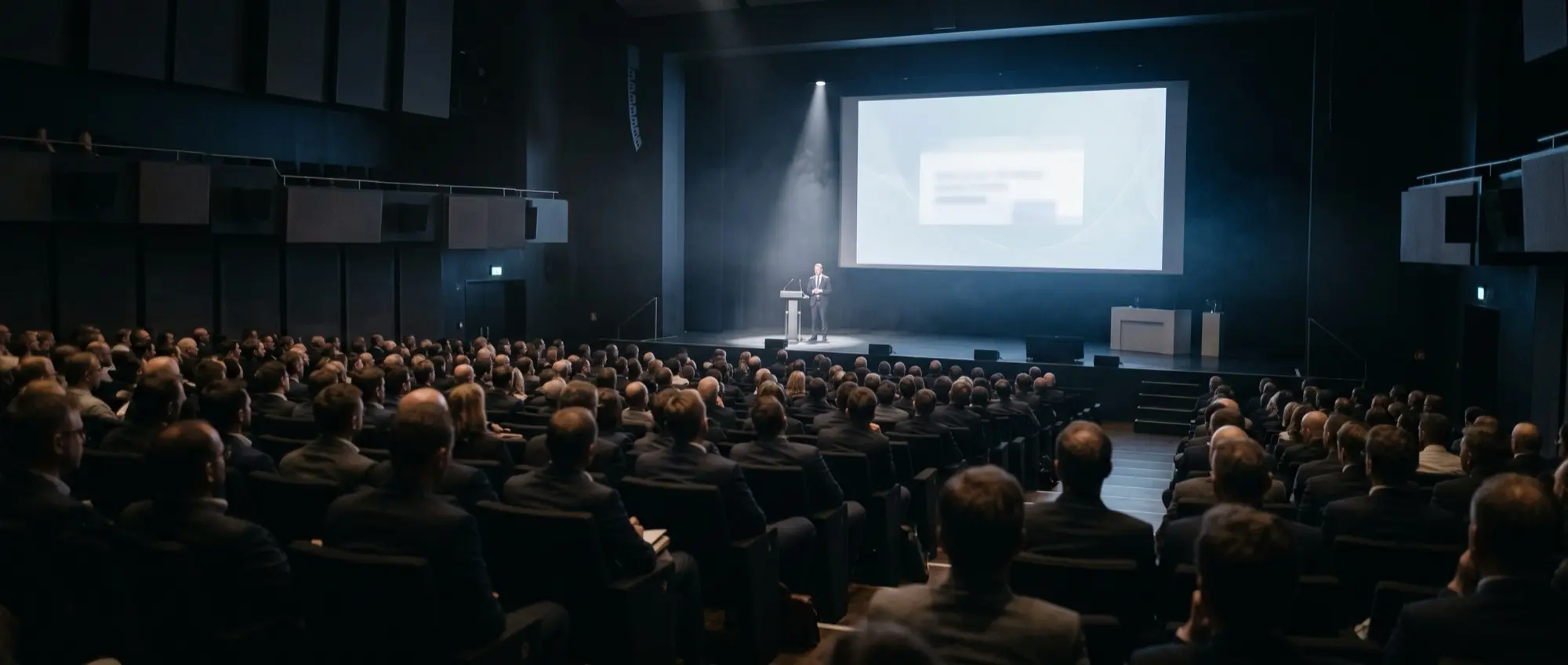
Every talk on that stage started here.
One tool for the whole program: proposals in, committee review, decisions, speaker logistics, and a schedule that won't double-book anyone.
Conference software costs five to six figures a year and sells you ten modules when you need five. Gather is those five, built properly, given away.
Ask exactly the right questions.
Any fields, in any order. Questions appear only when an answer calls for them, submissions route themselves to the right committee, and the deadline enforces itself on the server's clock, not the browser's.
Fair by architecture.
Weighted criteria and keyboard-speed scoring. In a blind round, author identity never leaves the server. Missing reviews never count as zeros, and declared conflicts sit out of the average.
It suggests. You sign.
A model reads the proposal against your rubric and returns a score with its reason— the part worth reading. Press once and the numbers land in your scorecard, where you change whatever you disagree with. Nothing is recorded until you save, and what saves is your review, under your name.
In a blind round the model is held to the same rule you are: it never sees a name you cannot. And with no API key configured it says so plainly rather than inventing a number — the whole app still runs, with nothing to buy.
Deciding is not sending.
Record verdicts all afternoon, nothing mails. Sending is its own deliberate act, and before it happens the server recounts every recipient and refuses if your screen has gone stale.

Forty speakers, zero chasing.
Every accepted speaker gets a private checklist that works on a phone. You watch one board, sorted late-first. Reminders space themselves, and calendar invites update when the schedule moves: Google, Outlook, iCal.
It objects before you let go.
Drag a session and the grid checks the room, the speaker and the track mid-flight. Conflicts are named while the card is still in your hand, with the fix one keystroke away.
One press. Every surface.
Publishing cuts a numbered snapshot. The public schedule, talk pages, speaker directory and your own website's embed all read that same snapshot. A half-finished edit can never leak, and any earlier version restores in one move.
Fast enough to forget it's there.
The product this replaces is famously slow. Speed here is a number, not an adjective.
On the record.
Struck lines are the incumbent's documented behaviour. The lines beneath are verifiable in the demo.
Free. As in yours.
The full product, MIT licensed, on your own machine. Seeded demo conference included, no accounts, no keys. Your speakers' data never lives on someone else's pricing page.
Break the demo on purpose.
Put one speaker in two rooms and watch it object before you've let go. Four minutes, no email address.